


It’s not always easy for everyone to learn about artificial intelligence technologies on their own, especially when there are so many different tools available and they’re constantly changing. Some are hesitant to get started, while others actively seek help, turning to loved ones, participating in community activities or training sessions, and hoping for clear explanations and encouragement.
However, helping others take their first steps also requires preparation. It is important not only to be familiar with the tools themselves but also to be able to select appropriate examples, focus on practical application, and foster critical thinking and the ability to evaluate the information received. Who provides knowledge to those we turn to for help – librarians, teachers, and other education specialists?
To this end, training sessions for adult educators were organized this year as part of the international project “GENIE: Generative AI for Inclusive Education and Empowerment.” The training took place at five partner organizations, including the Oak Grove Library, across four European countries: Lithuania, Italy, Slovenia, and Estonia. During the 16-hour training sessions, participants deepened their knowledge of artificial intelligence, tested practical tools, and learned how to use them responsibly.
Training Results
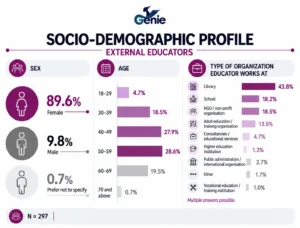
A survey of the 297 non-formal educators from all five partner organizations who participated in the training clearly revealed the value of the training and the positive feedback it received: 91.9 percent of respondents reported learning new information about artificial intelligence, and 76.8 percent rated the practical exercises very positively. The overall average rating for the training was 9.1 out of 10.
Of course, participants did not evaluate only their familiarity with specific tools. According to the survey data, they felt they had improved their ability to understand how artificial intelligence itself works, learned to formulate queries more effectively, and to critically assess the reliability of information, images, and videos. The most highly rated change in knowledge and skills was related to the ethical and responsible use of artificial intelligence.
How will the acquired knowledge be used?
Most participants confirmed that they plan to apply the knowledge gained during the training in practice: 81.8 percent of respondents intend to incorporate it into their daily activities, while 80.8 percent plan to use it in professional or personal projects. 71.7% of those surveyed intend to further deepen their knowledge of artificial intelligence. However, although participants rated their readiness to share knowledge about artificial intelligence with others at an average of 7.3 out of 10, only half (49.5 percent) currently plan to actively share the knowledge and training materials they have acquired with others.
These figures serve as a reminder that knowing how to use technology and being prepared to teach others are not the same thing. This may require even more practice, training resources, and support. Nevertheless, this training has already provided professionals with a solid foundation and empowered them to seek more targeted ways to apply their knowledge when working with different groups of people.
Training Materials Available to Everyone
As part of the “GENIE” project, training materials were developed and an online platform was created to explore the potential applications of artificial intelligence in various fields. It offers learning resources that can be useful both for those seeking a better understanding of these technologies and for professionals looking for ideas to apply to their work.
You can explore the project materials and learning opportunities on the platform igenie.gaminu.eu.

Co-funded by the European Union. Views and opinions expressed are however those of the author(s) only and do not necessarily reflect those of the European Union or the National Agency. Neither the European Union nor National Agency can be held responsible for them.