


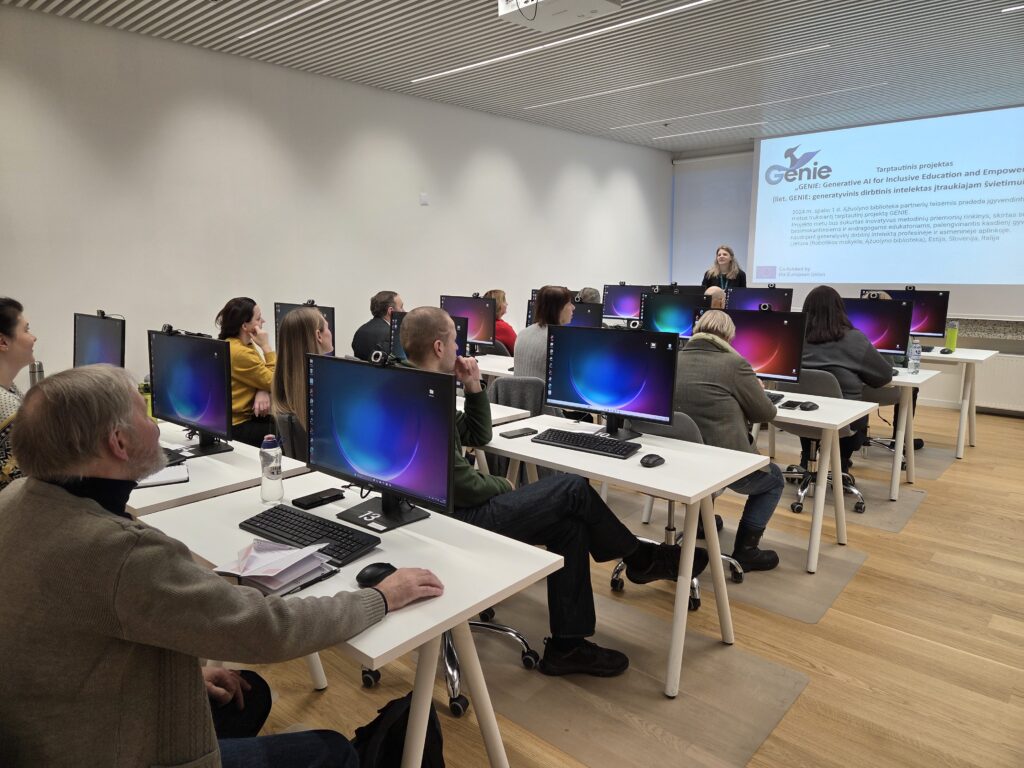
Artificial intelligence is gradually becoming more than just a topic for tech enthusiasts. More and more people are seeking to understand how to apply these tools in their daily lives. However, familiarity with these technologies is often accompanied by caution, uncertainty, and a fear of making mistakes. This was evident during the pilot artificial intelligence training sessions held at the Oak Grove Library, organized as part of the international project “GENIE: Generative AI for Inclusive Education and Empowerment.”
Participants in the training familiarized themselves with popular artificial intelligence tools and their practical application in everyday situations. They learned to use AI to search for information, plan trips, prepare presentations and documents, and create images, and also explored how to formulate queries effectively. The hands-on sessions allowed participants not only to observe how these technologies work but also to try them out for themselves in a safe environment.
According to the specialists from the Oak Grove Library who led the training, a very diverse audience participated, ranging from people encountering artificial intelligence for the first time to those who had already tried it before. The majority of participants were older adults, so the hands-on training format was particularly helpful. Live explanations, the opportunity to ask questions, and the chance to try out the tools independently helped participants feel more confident in exploring the technologies.
During the pilot training sessions, nearly 500 representatives from various social groups were trained in collaboration with partners in Lithuania, Estonia, Italy, and Slovenia.
A survey of participants conducted after the training revealed that people are interested not only in the possibilities of artificial intelligence, but also in how the technology itself works. It is important for participants to understand how much they can trust the information provided by AI and how to use it safely and responsibly.
The survey results showed that the impact of the training went far beyond basic familiarity with the tools. It had the greatest impact on overall AI literacy, a better understanding of how the technology works and its ethical and responsible use, a more favorable assessment, and greater self-confidence when using AI.
The survey results also revealed other trends – participants are concerned not only with the possibilities of the technology but also with the risks it poses. Among the most frequently mentioned topics in which participants would like to further expand their knowledge were AI security, critical evaluation of received content, disinformation detection, and responsible use of technology. Respondents also highlighted an interest in creating images, videos, and presentations, preparing documents, integrating with other programs, and applying artificial intelligence to work and daily tasks.
Read more on project website: https://igenie.gaminu.eu/
The “GENIE: Generative AI for Inclusive Education and Empowerment” project focuses not only on non-formal education for the general public, but also on training specialists so that they can independently teach this training program in the future. After developing the methodological materials and conducting pilot training sessions, the project entered a new phase this spring—the launch of training for educators.