

For several months, unusual conversations filled the halls of Kaunas County Public Oak Grove Library — communication happened not only through words, but also through hands, facial expressions, body language, and smiles. Together with the Kaunas Deaf Centre, the library since last summer is implementing the project “The Silent History of Kaunas”, aimed at fostering a better understanding of the Deaf community and creating more accessible library services for everyone.
The training cycle, led by Justina Vertelkaitė and Erika Slabadienė from Kaunas Deaf Center, invited participants not only to listen, but also to experience for themselves what it means to communicate differently.
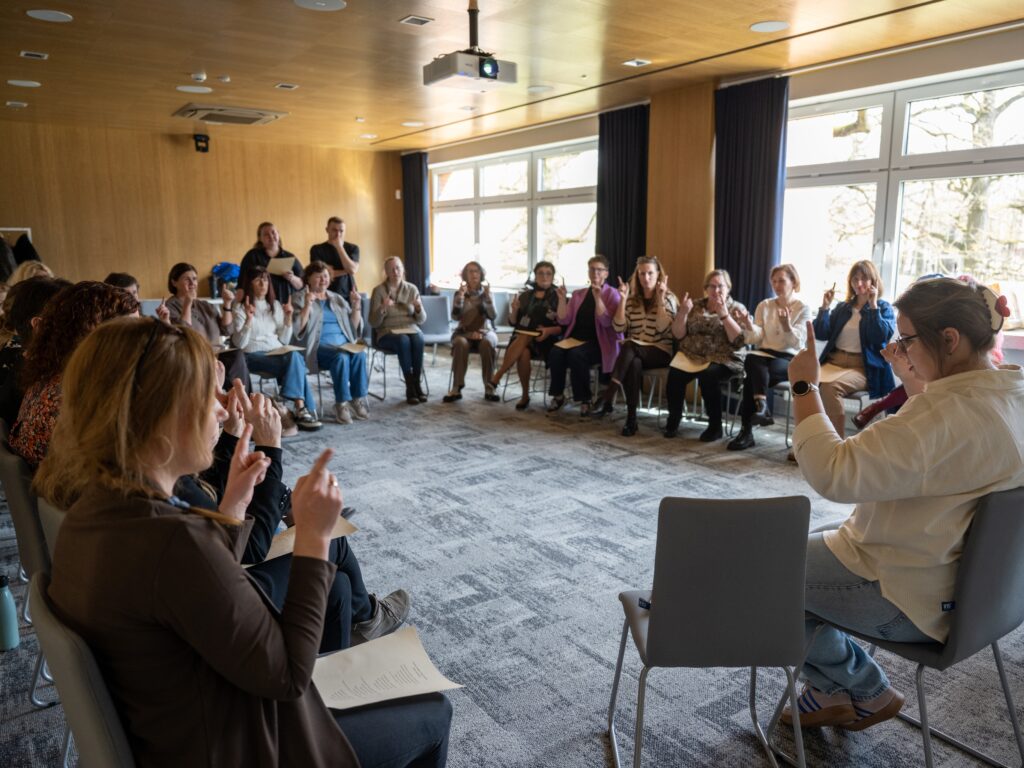
The February training sessions on Deaf culture and sign language were filled with both laughter and surprise. Librarians learned their first signs, discussed stereotypes about Deaf people that still persist in society, and tried to understand what it feels like when one’s primary means of communication is not the voice, but the eyes and hands. The sessions also included games, practical exercises, and presentations of musical performances in sign language.
In March, the focus shifted to adapting the information environment for Deaf people. Participants analyzed websites, discussed how to make events and information clearer and more accessible for people with hearing impairments, learned how to book sign language interpreters, and explored details that are often overlooked when planning public communication.
The final meetings held in April focused on the accessibility of library services, graphic accessibility symbols, the work of sign language interpreters, and a unique Deaf art form — sign language song performance. Of course, the sessions were not limited to theory alone. Musical performances in sign language attracted great interest and revealed themselves to be not merely songs, but a blend of dance, emotion, and theatre. Some participants admitted that it was the first time they truly realized how vivid, expressive, and creative sign language can be. Participants also learned to perform a song in sign language themselves, filling the Oak Hall of the library with both laughter and emotion.
Throughout the entire training cycle, Justina Vertelkaitė and Erika Slabadienė shared not only theoretical knowledge, but also created an open and welcoming atmosphere in which participants felt comfortable asking questions, engaging in discussions, and practically trying out new forms of communication. Participants attended the training not only from Kaunas city, but also from other parts of the Kaunas region, including Kaunas district, Šakiai, Marijampolė, and Vilkaviškis.
According to one participant, the word that best described the training sessions was “playful.” Although the topics discussed were serious — accessibility, communication barriers, and social norms — everything took place in a warm, engaging, and inviting atmosphere. For many participants, sign language became not only a new form of communication, but also an opportunity to reflect on their own communication habits. In the Deaf community, not only the hands matter, but also facial expressions, body language, and emotional openness. This encouraged participants to think about how often hearing culture hides genuine emotions and thoughts.
All of the training sessions were not only informative, but also deeply human — full of live interaction, practice, and discovery. The project “The Silent History of Kaunas” once again reminded everyone that true connection begins not with sound, but with the willingness to understand one another.
The project is funded by the European Cultural Foundation.
The Europe Challenge is a programme initiated by the European Cultural Foundation. It brings together libraries and communities to address Europe’s key transitions—social, digital, and green—by implementing creative solutions in their local areas. The 2025/26 edition is kindly supported by public funding through Arts Council England, Fondazione Cariplo, and the Scottish Library and Information Council.